The ancient yogic system of chakras provides one of the most practical and intuitive frameworks for understanding the relationship between body, mind, and spirit. Far from being abstract mysticism, chakra healing meditation offers a structured approach to identifying where you feel blocked in life and using targeted practices to restore balance. Whether you experience chronic anxiety, creative stagnation, difficulty speaking your truth, or a persistent feeling of disconnection, the chakra system maps these experiences to specific energy centers in the body and provides concrete tools for transformation. At Swaastik Yog School in Rishikesh, chakra work is woven throughout our teacher training and retreat programs because we have seen firsthand how it accelerates both personal growth and teaching skill.
This comprehensive guide walks you through all seven primary chakras, teaches you to recognize signs of imbalance, and provides specific chakra healing meditation techniques for each energy center.
What Are Chakras? The Energetic Anatomy of Yoga
The word "chakra" comes from Sanskrit and means "wheel" or "disc." In the yogic tradition, chakras are spinning centers of energy (prana) located along the central axis of the body, roughly corresponding to the spinal column. While ancient texts describe dozens of chakras, the system most commonly used in modern yoga focuses on seven primary energy centers, each associated with specific physical, emotional, and spiritual qualities.
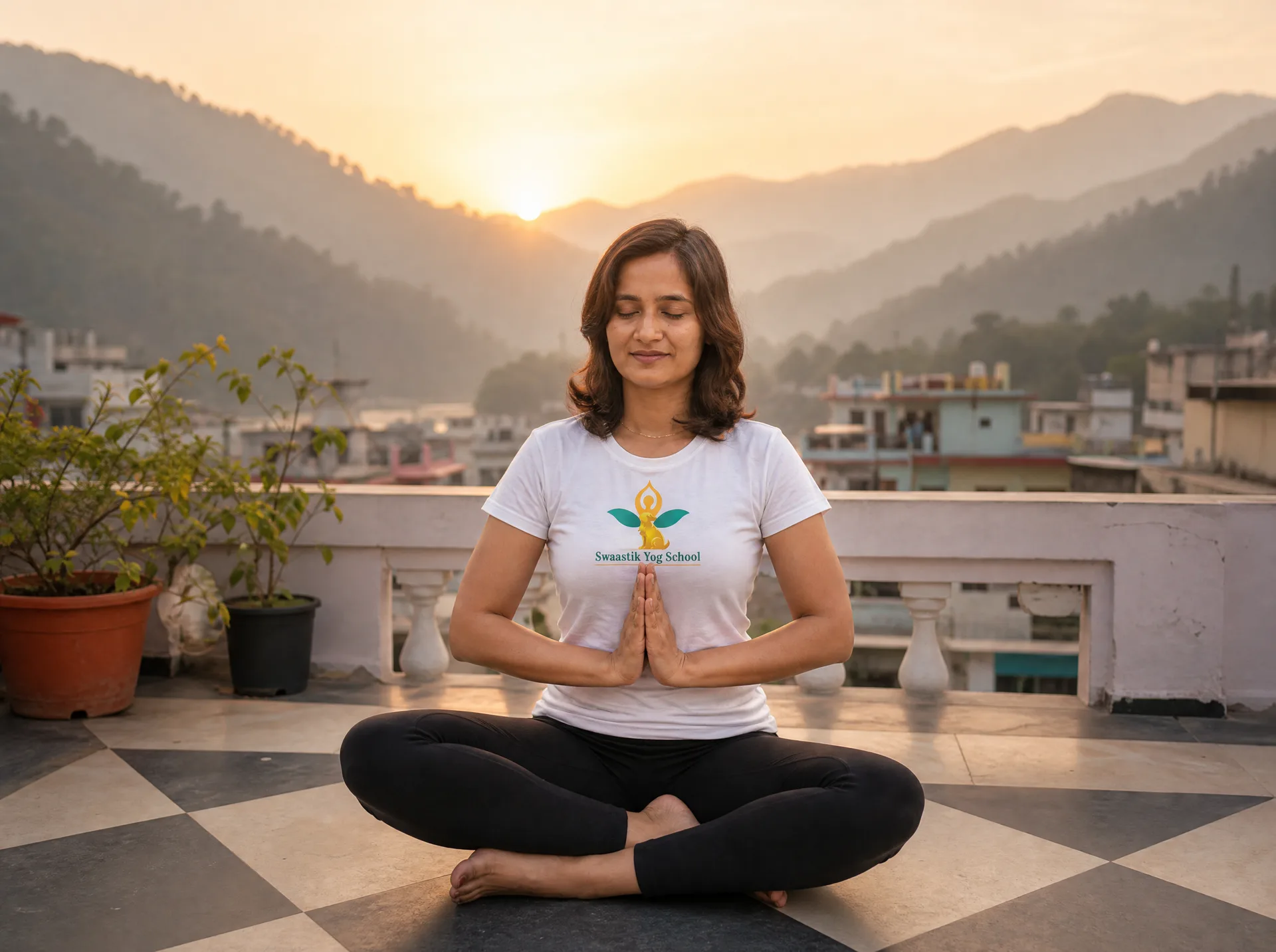
It is important to understand that chakras are not physical organs you can locate on an MRI. They exist in the pranamaya kosha (energy body), one of the five sheaths of human experience described in Vedantic philosophy. However, their locations correspond closely to major nerve plexuses and endocrine glands, which is why many modern practitioners view chakras as a poetic and practical map of the mind-body connection.
The 7 Chakras: Root to Crown
1. Muladhara (Root Chakra)
Location: Base of the spine, perineum
Color: Red
Element: Earth
Mantra: LAM
Associated qualities: Survival, security, grounding, physical health, financial stability
The root chakra is your foundation. It governs your sense of safety, your relationship with your physical body, and your basic survival needs. When the root chakra is balanced, you feel grounded, secure, and present in your body. When blocked, you may experience chronic anxiety, financial fear, restlessness, lower back pain, or immune system issues.
Chakra healing meditation for Muladhara: Sit on the ground (literally on earth if possible, as we often do on the banks of the Ganges during our training programs). Visualize a glowing red sphere at the base of your spine. With each inhale, imagine drawing red earth energy up through the ground into this sphere. With each exhale, chant "LAM" aloud, feeling the vibration in your pelvic floor. Continue for five to ten minutes. Supportive crystals include red jasper, garnet, and black tourmaline.
2. Svadhisthana (Sacral Chakra)
Location: Lower abdomen, about two inches below the navel
Color: Orange
Element: Water
Mantra: VAM
Associated qualities: Creativity, sexuality, emotions, pleasure, adaptability
The sacral chakra governs your relationship with pleasure, creativity, and emotional flow. When balanced, you experience healthy desires, creative inspiration, and emotional resilience. When blocked, you may struggle with creative blocks, emotional numbness or volatility, guilt around pleasure, reproductive issues, or lower abdominal tension.
Chakra healing meditation for Svadhisthana: Sit comfortably and place your hands on your lower belly. Visualize a warm orange glow radiating from this area, pulsing like water. As you breathe, imagine the orange light expanding with each inhale and softening with each exhale. Chant "VAM" and notice the vibration in your lower abdomen. Allow any emotions that arise to flow without resistance, like water moving around stones in a river. Carnelian and orange calcite are traditional crystal companions for this practice.
3. Manipura (Solar Plexus Chakra)
Location: Upper abdomen, between the navel and the base of the sternum
Color: Yellow
Element: Fire
Mantra: RAM
Associated qualities: Willpower, confidence, self-discipline, personal power, digestion
Manipura is the seat of your personal power and self-esteem. A balanced solar plexus manifests as healthy confidence, strong digestion, decisive action, and a clear sense of personal identity. Imbalance shows up as low self-esteem, indecisiveness, control issues, digestive problems, or an unhealthy need for external validation.
Chakra healing meditation for Manipura: Sit tall and visualize a bright yellow flame in your solar plexus region. With each breath, imagine this flame growing stronger and steadier, not wild and erratic, but powerful and controlled like the flame of a well-tended fire. Chant "RAM" and feel the vibration in your upper belly. Visualize the fire burning away self-doubt, fear of judgment, and any tendency to shrink yourself. Citrine and tiger's eye support this chakra.
4. Anahata (Heart Chakra)
Location: Center of the chest
Color: Green
Element: Air
Mantra: YAM
Associated qualities: Love, compassion, forgiveness, empathy, connection
The heart chakra bridges the lower (physical) and upper (spiritual) chakras. It governs your capacity for love, both giving and receiving. When balanced, you experience genuine compassion, healthy boundaries, forgiveness, and deep connection with others. Blockages manifest as jealousy, codependency, inability to forgive, grief that will not move, or chronic chest and upper back tension.
Chakra healing meditation for Anahata: Place both hands on the center of your chest. Feel your heartbeat. Visualize an emerald green light radiating from your heart in all directions. As you chant "YAM," imagine this green light expanding beyond your body, filling the room, reaching the people you love, and eventually encompassing all beings. Combine this with the loving-kindness phrases: "May all beings be happy. May all beings be free from suffering." Rose quartz and green aventurine are heart chakra stones.
5. Vishuddha (Throat Chakra)
Location: Throat
Color: Blue
Element: Ether (space)
Mantra: HAM
Associated qualities: Communication, self-expression, truth, listening, authenticity
The throat chakra governs your ability to express your truth clearly and to listen deeply. When balanced, you communicate honestly and kindly, express creativity freely, and set boundaries with ease. Imbalance shows as fear of speaking up, chronic sore throat, thyroid issues, inability to listen, excessive talking without substance, or a feeling that your voice does not matter.
Chakra healing meditation for Vishuddha: Sit with a gently elongated neck. Visualize a sphere of sky-blue light at your throat. Chant "HAM" slowly, feeling the vibration directly in the vocal cords. Between chants, sit in silence and practice simply listening to the sounds around you. This alternation between expression and reception balances both aspects of the throat chakra. Lapis lazuli and blue lace agate are supportive crystals.
6. Ajna (Third Eye Chakra)
Location: Between the eyebrows
Color: Indigo
Element: Light
Mantra: OM
Associated qualities: Intuition, insight, wisdom, imagination, clarity
The third eye chakra governs your intuition, inner wisdom, and capacity for insight beyond the five senses. A balanced Ajna manifests as clear thinking, strong intuition, vivid imagination, and the ability to see the bigger picture in life situations. Imbalance creates confusion, poor judgment, disconnect from intuition, headaches, eye strain, or an overactive imagination that produces anxiety. For a deeper exploration of this energy center, read our dedicated guide on balancing the Ajna chakra in Rishikesh.
Chakra healing meditation for Ajna: Close your eyes and direct your internal gaze to the point between your eyebrows. Do not strain; simply rest your attention there with gentle curiosity. Visualize an indigo light pulsing at this point. Chant "OM" slowly, feeling the vibration rise from the throat to resonate in the center of the skull. Trataka (candle gazing) is particularly powerful for Ajna activation. After gazing at a flame for one to three minutes, close your eyes and watch the afterimage at the third eye point. Amethyst and labradorite are traditional third eye stones.
7. Sahasrara (Crown Chakra)
Location: Top of the head
Color: Violet or white
Element: Thought / Cosmic energy
Mantra: Silence (or OM)
Associated qualities: Spiritual connection, universal consciousness, enlightenment, transcendence, bliss
The crown chakra represents your connection to something greater than yourself, whether you call it God, the universe, consciousness, or simply the interconnected web of all life. When open, you experience a sense of unity, peace, and purpose that transcends the personal. Imbalance manifests as spiritual disconnection, cynicism, rigid attachment to material identity, or at the other extreme, spiritual bypassing that disconnects you from earthly responsibilities.
Chakra healing meditation for Sahasrara: Sit in silence. After working through the lower six chakras, simply rest in open awareness. Visualize a thousand-petaled lotus of violet and white light opening at the crown of your head, connecting you to the sky above and the cosmos beyond. There is no mantra to chant here, only silence. Let go of trying to achieve anything. Let go of the meditator. Simply be. Clear quartz and selenite are crown chakra crystals.