If you have ever winced while bending to tie your shoes or felt a dull ache radiate across your lumbar region after a long day at your desk, you are not alone. Lower back pain is the leading cause of disability worldwide, affecting an estimated 619 million people according to the World Health Organization. The good news is that yoga for lower back pain offers a safe, evidence-based approach to relief that addresses not just symptoms but root causes. At Swaastik Yog School in Rishikesh, we have helped thousands of students from over sixty countries find lasting relief through targeted yoga practices designed specifically for the lumbar spine.
This guide focuses exclusively on the lower back, the lumbar region from L1 to L5 and the sacrum, rather than general back pain. If you are looking for a broader overview of yoga poses for the entire back, we recommend our companion article on the 10 best yoga poses for back pain. Here, we go deeper into the unique anatomy, causes, and targeted solutions for lower back issues.
Understanding Why Your Lower Back Hurts
Before diving into poses, it is critical to understand what causes yoga for lower back pain to be so effective. The lumbar spine bears the majority of your upper body weight. Unlike the thoracic spine, which is stabilized by the ribcage, the lumbar vertebrae rely almost entirely on muscles, ligaments, and fascia for support. When these soft tissues become weak, tight, or imbalanced, pain follows.
Common Causes of Lower Back Pain
- Prolonged sitting: Desk work, driving, and sedentary lifestyles cause the hip flexors to shorten and the glutes to weaken, pulling the pelvis into an anterior tilt that compresses the lumbar discs
- Weak core muscles: The transverse abdominis and multifidus muscles act as a natural corset for the lower back. When they are underdeveloped, the lumbar spine absorbs forces it was not designed to handle alone
- Tight hamstrings: Short hamstrings pull the pelvis into a posterior tilt during forward bending, forcing the lumbar spine to flex beyond its safe range
- SI joint dysfunction: The sacroiliac joint where the spine meets the pelvis is a common source of pain, particularly in women and those with hypermobility
- Disc issues: Bulging or herniated discs in the L4-L5 or L5-S1 region are extremely common and can cause both local pain and radiating symptoms down the leg
- Muscular imbalances: Uneven strength between the left and right sides, or between the anterior and posterior chains, creates compensatory patterns that stress the lumbar spine
Best Yoga Poses for Lower Back Pain Relief
The following poses specifically target the lumbar region. They are sequenced from gentle to moderate intensity. If you are new to yoga for lower back pain, start with the first four poses and add more as your body adapts over one to two weeks.
1. Supta Padangusthasana (Reclined Hand-to-Big-Toe Pose)
This is one of the safest hamstring stretches for people with lower back pain because the floor supports your lumbar spine throughout. Lie on your back, loop a strap around the ball of your right foot, and extend the leg toward the ceiling. Keep your left leg firmly grounded with the foot flexed. Hold for ten slow breaths on each side. The key is to keep both hips level on the mat rather than letting the stretching hip hike upward.
2. Cat-Cow (Marjaryasana-Bitilakasana)
This gentle spinal mobilization warms up the lumbar vertebrae and teaches segmental movement. On all fours with wrists under shoulders and knees under hips, inhale to drop the belly and lift the tailbone (cow), then exhale to round the spine and tuck the chin (cat). Move slowly through eight to ten rounds, paying particular attention to initiating the movement from the pelvis rather than the mid-back. This distinction matters for lower back relief because it ensures the lumbar spine actually moves rather than compensating.
3. Sphinx Pose (Salamba Bhujangasana)
Sphinx pose introduces gentle lumbar extension, which can be therapeutic for disc-related pain. Lie face down with elbows directly under shoulders and forearms parallel. Press the forearms down to lift the chest, but keep the lower ribs on the mat. Engage the lower abdominals by drawing the navel slightly toward the spine. Hold for five to eight breaths. This pose decompresses the anterior portion of the lumbar discs and strengthens the erector spinae muscles.
4. Supta Matsyendrasana (Supine Spinal Twist)
Lying on your back, draw both knees to the chest, then drop them to the right while extending the left arm out to the side. The twist occurs primarily in the thoracic spine, but the gentle rotation releases tension in the quadratus lumborum and the deep rotators of the lumbar region. Hold for eight to ten breaths per side. If your knees do not reach the floor comfortably, place a bolster or folded blanket underneath them.
5. Bridge Pose (Setu Bandhasana)
Bridge pose strengthens the glutes, hamstrings, and deep core muscles that directly support the lower back. Lie on your back with knees bent and feet hip-width apart. Press through the feet to lift the hips, squeezing the glutes at the top. Hold for five breaths, lower slowly, and repeat three to five times. Focus on lifting the hips evenly and avoiding excessive lumbar extension by keeping the ribs soft.
6. Ardha Apanasana (Knee-to-Chest Pose)
Draw one knee toward the chest while the other leg remains extended on the floor. This asymmetric version is more effective for lower back pain than hugging both knees because it allows you to address each side independently and maintain a neutral pelvis. Hold for eight breaths per side, gently rocking the knee in small circles to massage the lumbar muscles.
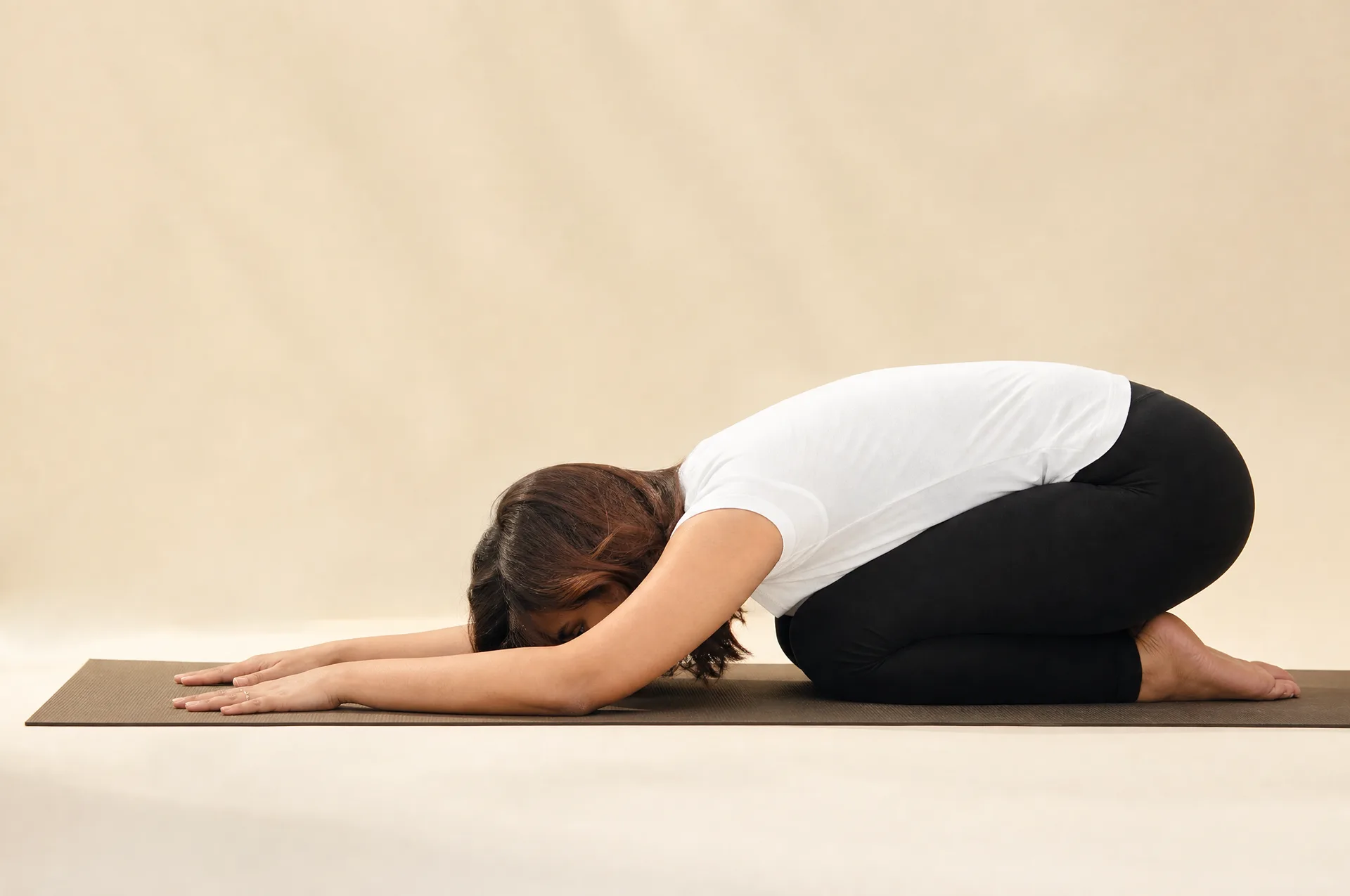
7. Supported Child's Pose (Balasana with Bolster)
Kneel with knees wide and a bolster lengthwise between your thighs. Fold forward over the bolster, turning your head to one side. This restorative variation provides gentle lumbar flexion without the gravitational load that standing forward folds impose on compromised discs. Stay for two to three minutes, switching the head direction halfway through.
8. Locust Pose (Salabhasana) Modified
Lie face down with arms alongside the body. On an inhale, lift the chest and legs just a few inches off the floor. This is not about height but about engagement. The erector spinae, multifidus, and glutes all fire to create this small lift. Hold for three breaths, rest, and repeat five times. This is one of the most research-supported poses for building the posterior chain strength that protects the lower back.