Quick answer: which yoga teacher certification should you get in India?
Pick by where you want to teach.
- Yoga Alliance RYT 200: the usual choice for studios and retreats worldwide. Train 200 hours at a Registered Yoga School, then register ($115 in year one). Our 22-day course costs $440 to $1,100 with room and meals.
- YCB (formerly QCI): India's voluntary government exam under the Ministry of Ayush. Level 1 needs 200 hours of training.
- Diplomas and degrees: what many government and college jobs in India ask for.
"Which certificate do I actually need?" is one of the most common questions we get. People hear about Yoga Alliance, Ayush, QCI and YCB, and it gets confusing fast.
This guide explains each one in plain words, with real fees from official sources, and shows which fits your goal: teaching abroad, teaching in India, or a government job.
What are the main yoga teacher certifications in India?
There are three main types of yoga teacher certification in India. Yoga Alliance registration is an international credential you earn by training at a registered school. YCB certification is a voluntary Indian government exam. Diplomas and degrees are full academic courses from institutes and universities.
| Yoga Alliance (RYT) | Yoga Certification Board (YCB) | Diplomas and degrees | |
|---|---|---|---|
| Who runs it | Yoga Alliance, a private US organisation | Ministry of Ayush, through the Morarji Desai National Institute of Yoga (MDNIY) | Government institutes and universities |
| What it is | A training course at a Registered Yoga School, then registration | An exam (theory and practical). YCB does not run courses itself. | A taught course with exams |
| Entry level | RYT 200 (200 hours) | Level 1, Yoga Protocol Instructor (at least 200 hours) | Certificate courses of 3 months or more |
| Time | 3 weeks full-time (our 200-hour runs 22 days) | Training first, then a weekend exam | 3 months to several years |
| Best for | Studios, gyms and retreats in India and abroad | Proving your skills inside India | Government, school and college jobs in India |
Do you need a certificate to teach yoga in India?
It depends on who hires you. India's government scheme is optional: YCB itself calls it a "voluntary certification program." In practice, the employer decides. Studios, hotels and retreat centres often ask for a Yoga Alliance RYT. Government posts ask for whatever is written in the job notice.
So the real question is not "which is official?" It is "who do I want to hire me?"
How do you become a yoga teacher in India?
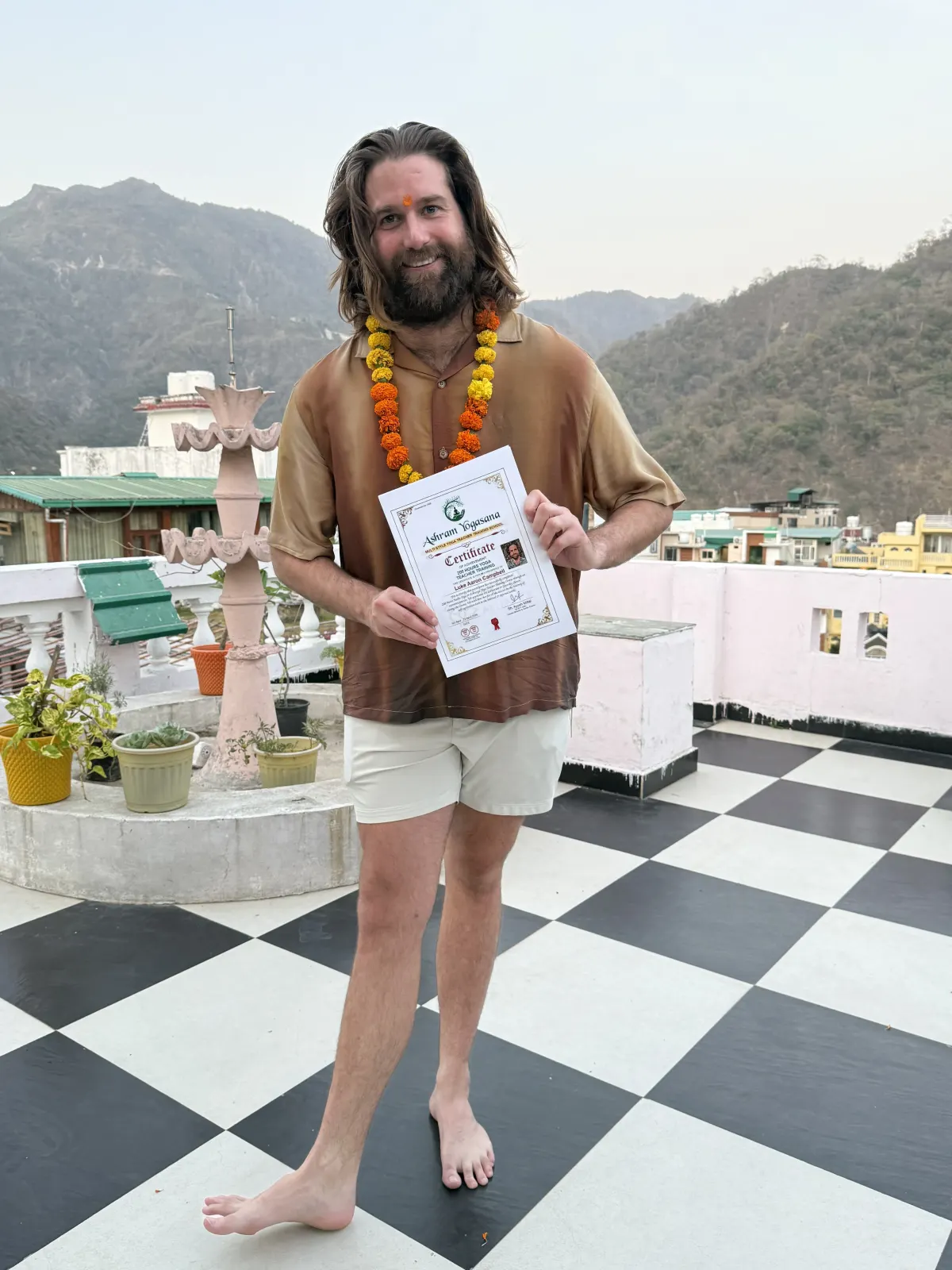
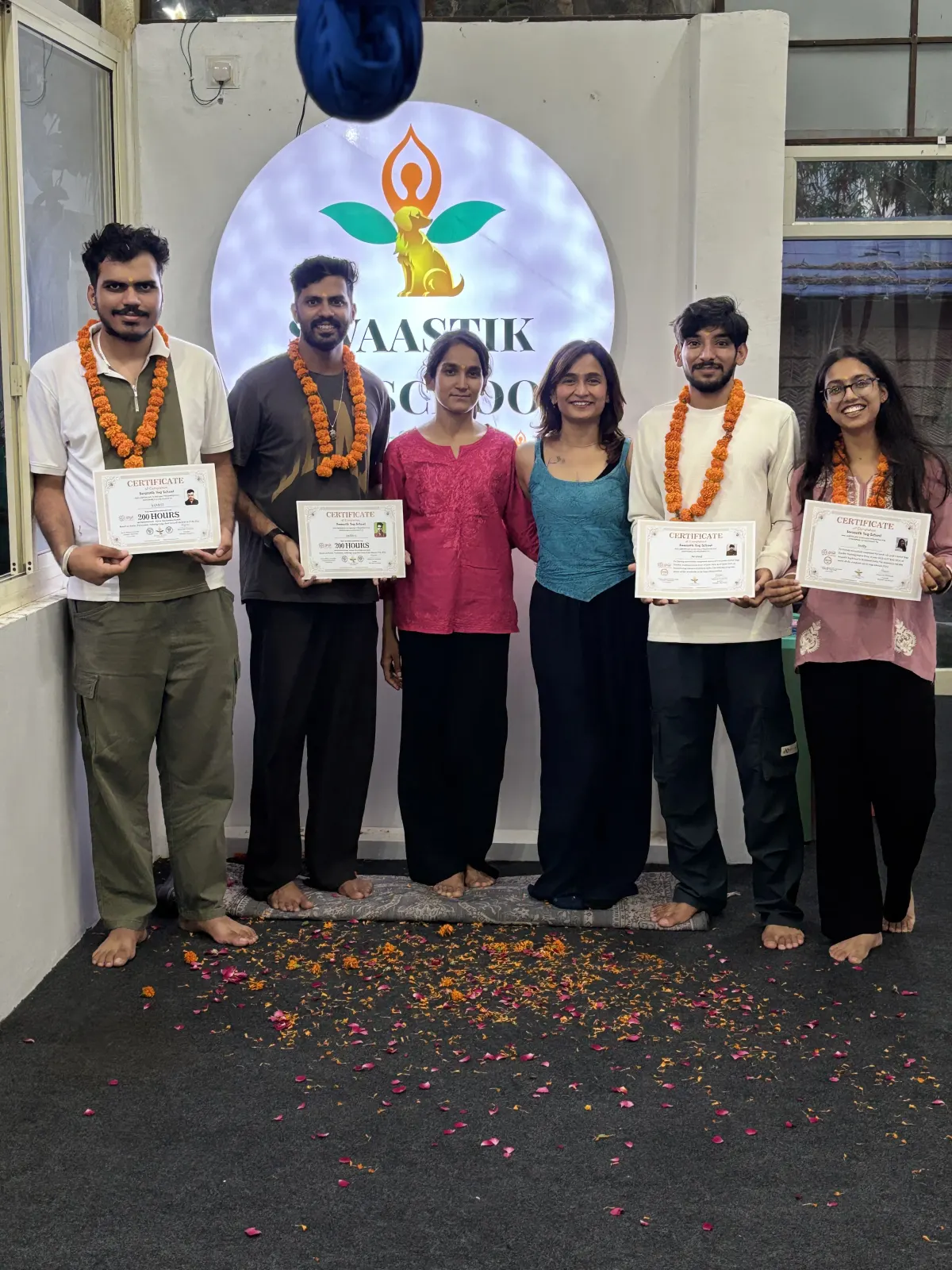
Most people become a yoga teacher in India in about a month. You complete a 200-hour teacher training at a Yoga Alliance Registered Yoga School, pass the school's final exam, and register online as an RYT 200. If you also want an Indian government credential, you can sit the YCB Level 1 exam after your 200 hours.
- Decide where you want to teach. Abroad, in Indian studios, or in a government job. This decides your certificate.
- Choose a registered school. Check it in the Yoga Alliance directory, not just on its website.
- Complete 200 hours. A full-time residential course takes about 3 weeks.
- Pass the final exam. A good school checks that you can actually teach a class.
- Register. Register with Yoga Alliance, and add a YCB exam if you need an Indian certificate too.
What is Yoga Alliance certification (RYS and RYT)?
Yoga Alliance is a US-based registry. It registers schools that meet its standards as Registered Yoga Schools (RYS). When you finish a course at an RYS, you can register yourself as a Registered Yoga Teacher (RYT). The school trains and certifies you. Yoga Alliance then registers you.
Yoga Alliance holds registered schools in every country to the same standards. So an RYT 200 earned in India is the same credential as one earned anywhere else.
Yoga Alliance credentials at a glance
| Credential | What you need |
|---|---|
| RYT 200 | One 200-hour course at an RYS 200 |
| RYT 500 | 500 hours at an RYS (one 500-hour course, or a 200-hour plus a 300-hour course), plus at least 100 hours of teaching |
| E-RYT 200 | RYT 200 plus 1,000 teaching hours and at least 2 years of teaching after your training |
| E-RYT 500 | 500 hours of training plus 2,000 teaching hours and at least 4 years of teaching since your first training |
| YACEP | A listing for experienced teachers who run continuing education courses for other teachers |
Two things often surprise people:
- There is no "RYT 100" or "RYT 300." A 100-hour course gives you a school certificate. A 300-hour course, added to a 200-hour, lets you register as RYT 500 once you have taught 100 hours.
- You keep it active. Yoga Alliance asks RYTs to log 75 hours of continuing education every 3 years: 45 hours of teaching and 30 hours of training.
How much does Yoga Alliance registration cost?
Yoga Alliance registration costs $115 in your first year. That is a one-time $50 application fee plus $65 annual membership dues. After that you pay $65 each year to stay registered. Upgrading later, for example from RYT 200 to RYT 500, costs a one-time $50. These fees are paid to Yoga Alliance, not to your school.
What is the Yoga Certification Board (YCB)? Is it the same as QCI?
The Yoga Certification Board is the Indian government's voluntary certification scheme for yoga professionals. It replaced the old QCI scheme. The Ministry of Ayush launched a certification scheme in June 2015 and asked the Quality Council of India (QCI) to run it. In 2018 the Ministry set up YCB, under the Morarji Desai National Institute of Yoga, to take it over.
So when people search for "QCI yoga certification" today, what they need is a YCB certificate. Old QCI certificates stay valid for their original period. YCB runs special renewal programmes to extend or upgrade them.
YCB levels for yoga teachers
| Level | Minimum training | Suggested education | What it lets you do |
|---|---|---|---|
| Level 1: Yoga Protocol Instructor | 200 hours | 10th standard | Teach basic yoga and the Common Yoga Protocol, for example in parks and housing societies |
| Level 2: Yoga Wellness Instructor | 400 hours | 12th standard | Teach yoga for wellness in schools, studios and workplaces |
| Level 3: Yoga Teacher and Evaluator | 800 hours | Graduate | Train teachers, assess candidates, teach in colleges and institutes |
| Level 4: Yoga Master | 1,600 hours | Graduate | Act as a master trainer for all levels |
Source: YCB Guideline for Yoga Professionals and the YCB FAQ page. YCB also has separate yoga therapy certificates.
How does the YCB exam work?
- Two parts. A multiple-choice theory paper and a practical test. You need 70% in each part to pass.
- Languages. The theory paper is in English and Hindi.
- Who can apply. Anyone. YCB has no age limit, and "open candidates" can apply without meeting the suggested education levels. You can apply straight for any level.
- Where. Exams run through approved certification bodies and accredited institutions, usually on weekends. YCB says exams can be held in India and abroad.
- Renewal. Certificates last a fixed period (YCB's documents give 3 to 5 years, depending on the level). You renew through YCB's Continuing Yoga Education Programme before it expires.
How much does YCB certification cost?
You pay a one-time enrolment fee to YCB and an exam fee to the body that runs your exam. The exam fee can vary by institution. This is the fee table in YCB's published guideline:
| Level | Indian candidates (enrolment + recommended exam fee) | Foreign candidates (enrolment + recommended exam fee) |
|---|---|---|
| Level 1: Protocol Instructor | ₹1,000 + ₹1,000 | $100 + $200 |
| Level 2: Wellness Instructor | ₹1,500 + ₹1,500 | $150 + $350 |
| Level 3: Teacher and Evaluator | ₹2,000 + ₹3,000 | $200 + $400 |
| Level 4: Yoga Master | ₹2,500 + ₹5,000 | $300 + $500 |
YCB has since published a notice on revised enrolment fees. Check the current amount on the official YCB website before you pay. These fees are only for the exam. Any training course you take to prepare costs extra.