Back to Blog
Wellness

Embracing Your Yoga Journey in Your 40s

· Updated
Share this post:
Embracing Your Yoga Journey in Your 40s

Yoga in your 40s: protect your joints, build strength and bone, handle perimenopause gently, and follow a 25-minute routine with simple modifications.

Quick answer: how should you practise yoga in your 40s?

In your 40s, practise yoga for strength, balance and recovery as much as for flexibility. Warm up longer, load your muscles with standing and holding poses, use props without guilt, and allow a rest day between harder sessions. A 25-minute routine four days a week is a realistic base, and it can be adapted for stiff joints, old injuries and hormonal changes.

  • Strength matters more now: muscle and bone density tend to decline from midlife, and weight-bearing poses may help.
  • Recovery is slower: alternate stronger and gentler days.
  • Hormones change: perimenopause can affect sleep, mood and energy; adjust practice to the day you are having.
  • Check with your doctor first if you have heart, blood pressure, bone or joint conditions.
Written by the teaching team at Swaastik Yog School, a women-led Yoga Alliance school in Tapovan, Rishikesh, founded in 2015 by Mayuri Shewale, E-RYT 500. This article is general guidance, not medical advice.

Embracing Your Yoga Journey in Your 40s
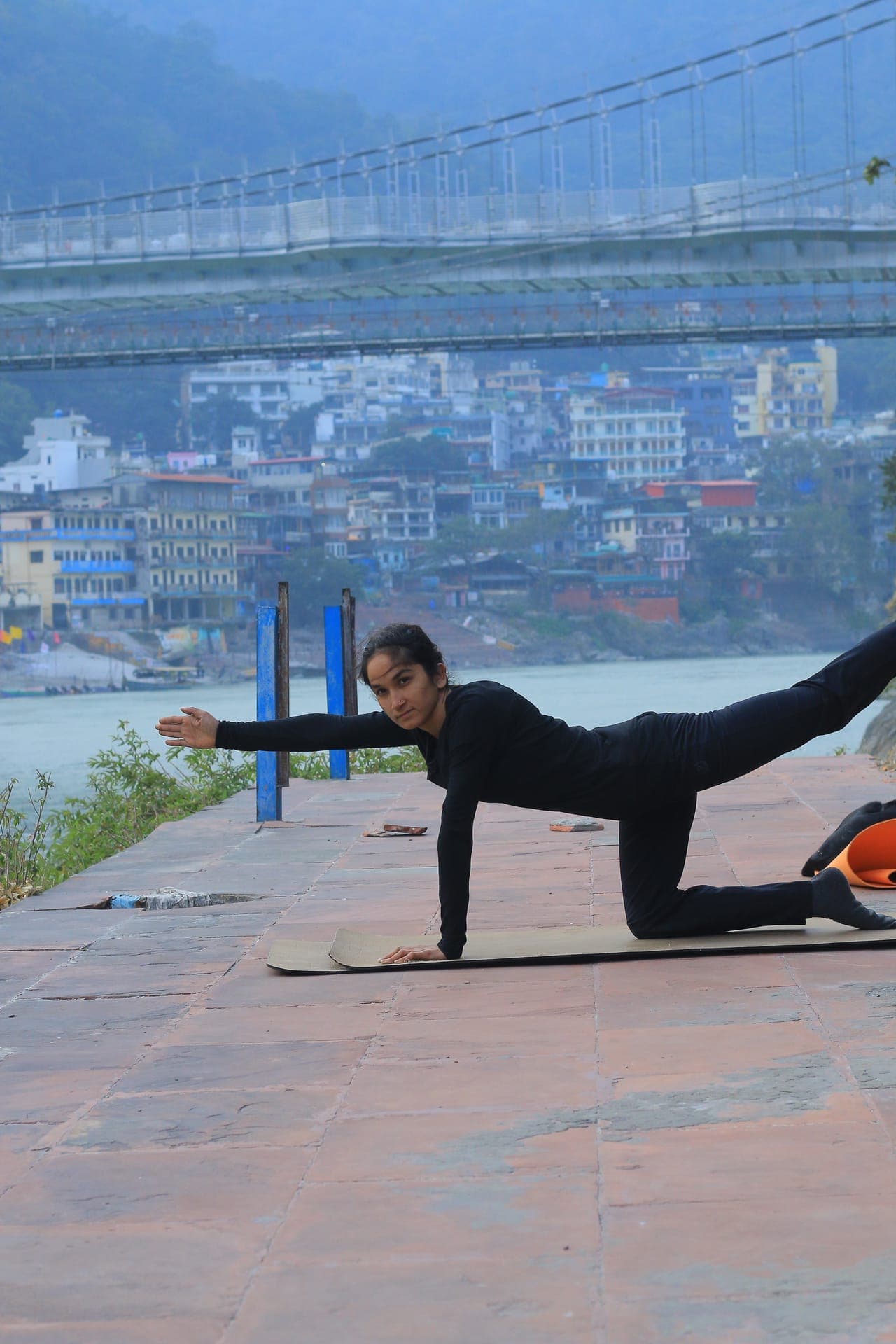
Morning practice by the Ganga in Rishikesh.

What changes in your body in your 40s

Nothing switches off at 40, but several slow trends become noticeable. Knowing them helps you practise smarter rather than harder.

Joints and connective tissue

Tendons and ligaments tend to become less elastic, and old injuries in knees, shoulders or the lower back may speak up more. Long, cold holds in deep stretches can aggravate them. Warm up with movement first, keep a slight bend in the knees and elbows, and treat sharp or joint-line pain as a stop sign, not a challenge.

Recovery

Soreness after a strong class often lasts longer than it did at 30. That does not mean you should practise less, only that you should vary intensity. Pair a strong day with a gentle or restorative day, and protect your sleep.

Muscle and bone

Research suggests that muscle mass and bone density gradually decline from midlife, and for women the decline in bone density can speed up around menopause. Weight-bearing and resistance work may help slow this. In yoga, that means standing poses held for several breaths, chair pose, plank variations, and slow transitions that make your muscles work. Yoga complements, but does not replace, other strength training your doctor may recommend.

Hormones and perimenopause

For many women, the 40s bring perimenopause: cycles may change, and sleep, mood, energy and body temperature can become less predictable. Everyone's experience is different. Some find that slower practices, cooling breathwork and longer relaxation help them feel more settled; others feel better with a strong, sweaty practice. Let the day decide. If symptoms are affecting your quality of life, speak to your doctor or a gynaecologist, as there are effective medical options to discuss. Men also see gradual hormonal shifts in this decade, and the same principles of strength, recovery and sleep apply.
Opleidingszoeker

Weet je nog niet welke opleiding bij je past?

We hebben vergelijken makkelijk gemaakt. Bekijk elke docentenopleiding, retreat en les naast elkaar — met actuele startdata, prijzen en kameropties — allemaal op één pagina.

  • Filter op maand
  • Filter op budget
  • Filter op kamertype
Vergelijk alle opleidingenKost 30 seconden · Geen account nodig

A 25-minute routine for your 40s

Practise four days a week. Move slowly, breathe through your nose, and use a block or wall wherever it helps.

TimePracticeFocus
0 to 3 minLying breath awareness, knees bent, slow exhalesSettle and check in with the body
3 to 8 minJoint warm-up: ankle, knee, hip circles; cat-cow; shoulder rollsWarm the joints before load
8 to 12 minTwo slow half sun salutations with hands on blocksGentle full-body warm-up
12 to 17 minChair pose, Warrior II, side angle with forearm on thigh, 5 breaths eachLeg strength and weight-bearing
17 to 20 minTree pose near a wall, 30 seconds each side, then bridge 3 x 5 breathsBalance and glute strength
20 to 22 minSupine twist and reclined hamstring stretch with a strapMobility without strain
22 to 25 minSavasana or legs up the wallRecovery and nervous-system downshift

Modifications that make yoga work in your 40s

  • Knees: pad them with a folded blanket in kneeling poses; in lunges, keep the front knee over the ankle.
  • Lower back: bend your knees in forward folds and lift the chest before folding; avoid deep twists if they cause pain.
  • Shoulders and wrists: drop to forearms in plank and downward dog, or practise at a wall.
  • Balance: keep a wall or chair within reach; balance usually improves quickly with regular practice.
  • Hot flushes or poor sleep: choose a cooler room, slower flows, and longer exhales in the evening.
  • Inversions: swap headstand for legs up the wall unless a teacher has assessed your neck and blood pressure.

For more ideas on balancing mobility with strength, read our guide to yoga for flexibility and strength.

When to see a doctor before or during practice

Yoga is generally safe, but check with your doctor before starting or intensifying it if any of these apply:

  • High or low blood pressure, heart disease, or chest pain on exertion.
  • Diagnosed osteopenia or osteoporosis (some deep forward folds and twists may need to be avoided).
  • Recent surgery, a joint replacement, or a disc problem in the neck or back.
  • Glaucoma or eye pressure issues (inversions may not be suitable).
  • Dizziness, numbness, or pain that persists or worsens after practice.

Always tell your teacher about conditions and injuries before class so they can offer alternatives.

Is a teacher training or retreat right for you in your 40s?

Many students in their 40s come to a course wanting depth rather than performance: a better understanding of anatomy, breathwork and philosophy, and a sustainable practice for the next decades. If three or four weeks away is too much, a 100-hour yoga teacher training offers a shorter, structured immersion. If you mainly want rest and a reset, our 3, 5 or 7-day yoga retreats in Tapovan combine daily practice, breathwork and quiet time. With batches of no more than 12, teachers have time to adapt poses to your joints and energy.

Next step

Start with the 25-minute routine above for four weeks and notice how you sleep, move and recover. If you want guided depth without a full month away, explore our 100-hour yoga teacher training in Rishikesh, led by founders Mayuri Shewale and Rahul Badoni, both E-RYT 500 with 15+ years of teaching.

Ready to Start Your Yoga Journey?

Join our Yoga Alliance certified teacher training in Rishikesh — or just ask us a question. We reply to every message personally.

About the Author

Mayuri Shewale, Founder & Lead Yoga Teacher at Swaastik Yog School

Mayuri Shewale

Founder & Lead Yoga Teacher

E-RYT 500 · 15+ years teaching

Mayuri Shewale teaches Hatha Yoga, Aerial Yoga, Vinyasa Yoga at Swaastik Yog School in Rishikesh, sharing 15+ years of hands-on experience with students from around the world.

Related Articles

A Complete Guide to Aerial Yoga

A Complete Guide to Aerial Yoga

Discover the magic of aerial yoga! Learn about its benefits, explore popular poses, and find out how to become a certified aerial yoga instructor. #AerialYoga #YogaTeacherTraining

Read More
6 Yoga Poses for High Blood Pressure

6 Yoga Poses for High Blood Pressure

Six gentle, restorative yoga poses that help lower high blood pressure naturally — with the slow-breathing technique that makes them work and the poses to avoid if you are hypertensive.

Read More
Cultivating Well-being The Advantages of Antenatal Yoga for Women’s Health

Cultivating Well-being The Advantages of Antenatal Yoga for Women’s Health

How antenatal (prenatal) yoga supports a healthier pregnancy — easing back pain, improving sleep and breath control, and preparing body and mind for labour.

Read More

Vragen? Neem contact op!

Of je nu interesse hebt in onze yogadocentenopleidingen, retreats of drop-in lessen: we helpen je graag op weg in je yogareis. Vul het formulier in of chat direct met ons via WhatsApp.

We reageren binnen 24 uur · 4.8★ uit 138 Google-reviews