Back to Blog
Practice

Aerial Yoga in Rishikesh & Home Practice Guide

· Updated
Share this post:
Aerial Yoga in Rishikesh & Home Practice Guide

Yes, with care. What you need to practise aerial yoga at home, which poses to learn in person first, rigging safety, and where to learn in Rishikesh.

Quick answer: can you learn aerial yoga at home?

You can practise aerial yoga at home, but it is much safer to learn the basics, especially inversions, from a teacher in person first. The real risks at home are the rigging, not the poses: a hammock needs a load-rated anchor point or a purpose-built frame, rated hardware and clear space around it. Learn the grips, wraps and safe inversion entries in a class or short course, then use home practice to repeat what you already know.

  • Fine to do at home: seated and supported stretches, restorative poses, and wraps you have already learnt with a teacher.
  • Learn in person first: any full inversion, hands-free hanging and transitions between wraps.
  • Never improvise rigging: no door frames, curtain rails, light fittings or untested ceiling hooks.

Written by the teaching team at Swaastik Yog School, Rishikesh, a Yoga Alliance-registered school (RYS 200, 300, 500 and YACEP) with dedicated aerial training.

Aerial Yoga at Home
Aerial yoga feels light and playful, but the hammock carries your full weight, so how it is hung matters more than which pose you try.

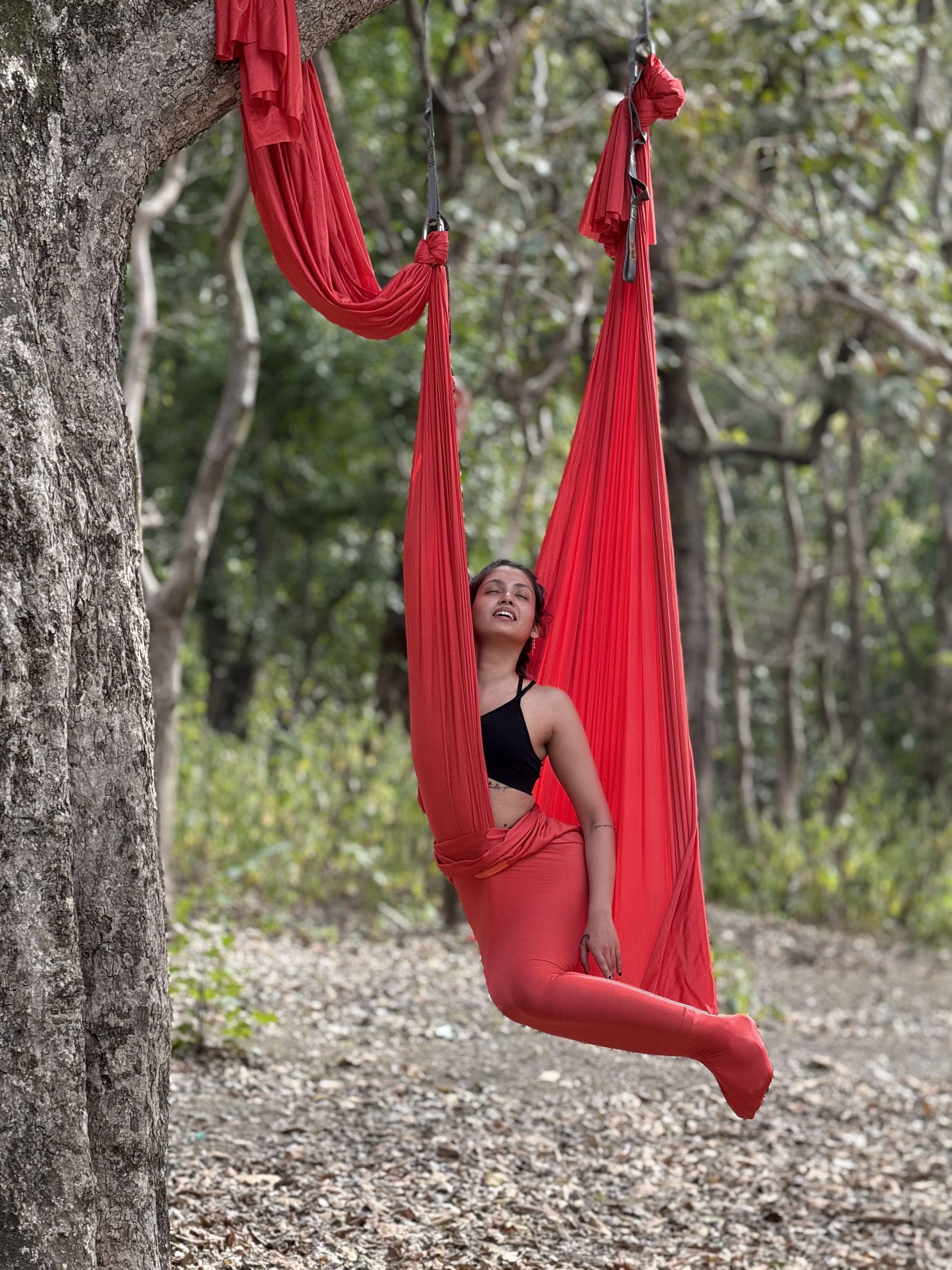
Aerial yoga uses a soft fabric hammock, hung from the ceiling, to support part or all of your weight while you stretch, invert and move. The hammock makes some poses easier and some feel almost effortless. That is exactly why people want to try it at home, and also why it needs care. Here is an honest guide to what you can safely do on your own, what to set up, and when you need a teacher.

What do you need for aerial yoga at home?

You need four things: a safe anchor point, rated hardware, a proper aerial hammock and enough clear space.

  • An anchor point you can trust. This is either a structural ceiling beam that a qualified builder or engineer has confirmed can take dynamic loads, or a freestanding aerial frame made for the purpose. Plasterboard, false ceilings and ordinary screw hooks are not safe.
  • Rated hardware. Use climbing-grade or rigging-grade carabiners, a swivel and daisy chains or slings, each with a stated working load limit. When you swing, bounce or drop into a wrap, the force on the hardware is several times your body weight, so choose ratings well above it.
  • A proper aerial hammock. Look for low-stretch fabric sold specifically for aerial yoga, not a garden hammock or stretchy silks. Ask the seller for the fabric's load rating.
  • Clear space and padding. Leave room to swing in every direction without touching furniture or walls, and put a thick mat or crash mat underneath. Keep pets and children out of the area while you practise.

If you are not sure whether your ceiling is strong enough, assume it is not and use a frame, or ask a professional. This is the one part of home aerial yoga where you should not save money.
Kurshittare

Osäker på vilken kurs som passar dig?

Vi har gjort det enkelt att jämföra. Se alla lärarutbildningar, retreats och klasser sida vid sida – med aktuella startdatum, priser och rumsalternativ – på en och samma sida.

  • Filtrera på månad
  • Filtrera på budget
  • Filtrera på rumstyp
Jämför alla kurserTar 30 sekunder · Ingen registrering behövs

Which aerial poses are safe to learn at home?

Poses that keep your feet on or near the floor are reasonable to explore at home; full inversions should be learnt with a teacher first.

Type of practiceLearn at home?Why
Supported standing stretches (hammock at hip height, feet on the floor)Yes, with careYou stay grounded and can step out at any time.
Seated and cocoon poses (sitting or lying inside the fabric, low to the floor)YesLow height and full support. Good for relaxation and gentle stretching.
Basic wraps and gripsAfter a lessonWrong wraps can slip or cut off circulation. Learn the correct tie first.
Supported inversions (hanging upside down from the hips)Only after in-person teachingEntry and exit are where most falls happen. You need a teacher to spot and correct you.
Hands-free hangs, flips and dropsNoHigh load and high risk. Practise only with a qualified teacher present.

Can you learn aerial yoga from YouTube?

Videos are useful for revising poses you have already been taught, but they cannot see you, spot you or tell you that your wrap is wrong.

The problem with learning inversions from a screen is that the dangerous moments are small details: where your hands are as you tip back, whether the fabric is under your hip bones or your waist, and how you come back up. A teacher sees these instantly. On your own, you will usually find out only when something feels wrong upside down. If you do use videos, choose ones from qualified aerial teachers that explain set-up and safety, and stop the first time you feel dizzy, numb or unsure.

Who should not practise aerial yoga without advice?

Because aerial yoga includes inversions and pressure from the fabric, some people should talk to their doctor before trying it, at home or in a studio.

That includes anyone who is pregnant, or who has high or low blood pressure, glaucoma or other eye conditions, a heart condition, vertigo, recent surgery, osteoporosis, or a head, neck, shoulder or back injury. Aerial practice may help some people feel more mobile or relaxed, but it is not a treatment for any condition. Do not practise after a heavy meal, and come out of inversions slowly.

A sensible way to start: a simple plan

  1. Take a few in-person classes first. Learn how to get in and out of the hammock, the basic wraps and one or two supported inversions with a teacher beside you.
  2. Set up your home rig properly. Use a frame or a professionally checked beam and rated hardware. Set the hammock at about hip height for most work.
  3. Practise only what you have been taught. Keep home sessions short, 20 to 30 minutes, and focus on stretching, restorative poses and the wraps you know.
  4. Check your gear before every session. Look for fraying fabric, worn slings and gates that do not close fully on carabiners.
  5. Go back to a teacher to progress. Every time you want to learn something new, especially an inversion, learn it in person first.

Where to learn aerial yoga properly in Rishikesh

If you are in or near Rishikesh, the quickest way to start is a drop-in aerial class. Swaastik Yog School runs a beginner-friendly aerial class Monday to Saturday as part of our drop-in classes schedule. It focuses on supported inversions and spinal decompression, and you can simply join a session to see whether aerial yoga suits you.

If you want to learn the hammock in depth, set up your own practice safely, or teach others, our Aerial Yoga Teacher Training is a 7-day, 50-hour residential course that starts every Monday. It covers rigging and safety, inversions, sequencing, spotting and choosing and installing equipment, and is certified as Yoga Alliance continuing education (YACEP). It is taught by Priya Sharma, our aerial yoga teacher, in batches of up to 12, and costs from $195 all-inclusive with accommodation and two sattvic meals a day. You can also explore our aerial-only programme at Aerial Rishikesh.

Honest trade-offs

  • Home practice is convenient but limited. You will maintain and deepen what you know, but you will rarely learn new skills safely on your own.
  • Good equipment costs money. A frame or professional rigging, plus rated hardware and a proper hammock, is a real expense. Cheap kits often cut corners on exactly the parts that matter.
  • A course takes time. A week in Rishikesh is a bigger commitment than a few online videos, but you leave knowing how to rig, spot and progress safely.

Next step

If you are in Rishikesh, try a beginner aerial class from our drop-in schedule. If you want to learn the hammock properly, rig your own space and perhaps teach, see dates and prices for our Aerial Yoga Teacher Training in Rishikesh.

Ready to Start Your Yoga Journey?

Join our Yoga Alliance certified teacher training in Rishikesh — or just ask us a question. We reply to every message personally.

About the Author

Rahul Badoni, Co-Founder & Philosophy Teacher at Swaastik Yog School

Rahul Badoni

Co-Founder & Philosophy Teacher

E-RYT 500 · 15+ years teaching

Rahul Badoni teaches Yoga Philosophy, Ashtanga Yoga, Meditation at Swaastik Yog School in Rishikesh, sharing 15+ years of hands-on experience with students from around the world.

Related Articles

How to Choose the Right Yoga Style for You

How to Choose the Right Yoga Style for You

Hatha, Vinyasa, Ashtanga, Yin, Iyengar, Kundalini, Aerial or Restorative? Compare pace and intensity side by side, then take a quick quiz to find your style.

Read More
Difference Between Hatha and Vinyasa Yoga Explained

Difference Between Hatha and Vinyasa Yoga Explained

Hatha vs Vinyasa yoga: detailed comparison of pace, physical demands, breathing, benefits, and which style suits your goals.

Read More
Ashtanga Yoga for Beginners: Complete Guide

Ashtanga Yoga for Beginners: Complete Guide

Start your Ashtanga yoga journey. Learn about the 8 limbs, Primary Series, how to begin, common mistakes, and benefits of this powerful practice.

Read More

Har du frågor? Hör av dig!

Oavsett om du är intresserad av våra yogalärarutbildningar, retreats eller drop-in-klasser hjälper vi dig gärna på din yogaresa. Fyll i formuläret eller chatta direkt med oss på WhatsApp.

Vi svarar inom 24 timmar · 4.8★ från 138 Google-recensioner